Marine biodiversity loss, largely through overfishing, is increasingly impairing the capacity of the world’s oceans to provide food, maintain water quality, and recover from perturbations (Worm et al. 2006). Yet marine fisheries provide employment and income for 0.2 billion people around the world, and fishing is the mainstay of the economy of many coastal regions; 41 million people worked as fishers or fish farmers in 2004, operating 1.3 million decked vessels and 2.7 million open boats (FAO 2007). An estimated 14 million metric tons of fuel was consumed by the fish-catching sector at a cost equivalent to US$22 billion, or ~25% of the total revenue of the sector. In 2004, reported catches from marine and inland capture fisheries were 85.8 million and 9.2 million tons, respectively, which was worth US$84.9 billion at first sale. Freshwater catches taken every year for food have declined recently but on average 500 000 tons are taken from the Mekong river in South-East Asia; 210 000 tons are taken from the Zaire river in Africa; and 210 000 tons of fish are taken from the Amazon river in South America. Seafood consumption is still high and rising in the First World and has doubled in China within the last decade. Fish contributes to, or exceeds 50% of the total animal protein consumption in many countries and regions, such as Bangladesh, Cambodia, Congo, Indonesia, Japan or the Brazilian Amazon. Overall, fish provides more than 2.8 billion people with ~20% or more of their average per capita intake of animal protein.
The oscillation of good and bad years in marine fisheries can also modulate the protein demand from terrestrial wildlife populations (Brashares et al. 2004). The share of fish in total world animal protein supply amounted to 16% in 2001 (FAO 2004). These ‘official’ landing statistics tend to severely underestimate catches and total values due to the enormous unrecorded contribution of subsistence fisheries consumed locally. Although the world’s oceans are vast, most seascapes are relatively low-productivity, and 80% of the global catch comes from only ~20% of the area. Approximately 68% of the world’s catch comes from the Pacific and northeast Atlantic. At current harvest rates, most of the economically important marine fisheries worldwide have either collapsed or are expected to collapse. Current impacts of overexploitation and its consequences are no longer locally nested, since 52% of marine stocks monitored by the FAO in 2005 were fully exploited at their maximum sustainable level and 24% were overexploited or depleted, such that their current biomass is much lower than the level that would maximize their sustained yield (FAO 2007). The remaining onequarter of the stocks were either underexploited or moderately exploited and could perhaps produce more. The Brazilian sardine (Sardinella brasiliensis) is a classic case of an overexploited marine fishery. In the 1970s hey-day of this industry, 200 000 tons were captured in southeast Brazil alone every year, but landings suddenly plummeted to <20 000 tons by 2001. Despite new fishing regulations introduced following its collapse, it is unclear whether southern Atlantic sardine stocks have shown any sign of recovery.
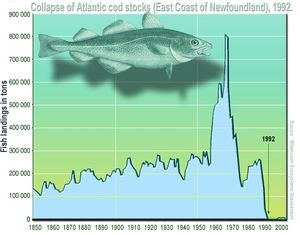
With the possible exception of herring and related species that mature early in life and are fished with highly selective equipment, many gadids (e.g. cod, haddock) and other non-clupeids (e.g. flatfishes) have experienced little, if any, recovery in as much as 15 years after 45–99% reductions in reproductive biomass (Hutchings 2000). Worse still, an analysis of 147 populations of 39 wild fish species concluded that historically overexploited species, such as North Sea herring, became more prone to extreme year-on-year variation in numbers, rendering them vulnerable to economic or demographic extinction (Minto et al. 2008). Marine fisheries are an underperforming global asset—yields could be much greater if they were properly managed. The difference between the potential and actual net economic benefits from marine fisheries is in the order of US$50 billion per year—equivalent to over half thevalue of the global seafood trade (World Bank 2008). The cumulative economic loss to the global economy over the last three decades is estimated to be approximately US$2 trillion, and in many countries fishing operations are buoyed up by subsidies, so that the global fishery economy to the point of landing is already in deficit. Commercial fishing activities disproportionately threaten large-bodied marine and freshwater species (Olden et al. 2007). This results in fishermen fishing down the food chain, targeting ever-smaller pelagic fish as they can no longer capture top predatory fish. This is symptomatic of the now widely known process of ‘fishing down marine food webs’. Such sequential
size-graded exploitation systems also take place in multi-species assemblages hunted in tropical forests (Jerozolimski and Peres et al 2003).
In the seas, overexploitation threatens the persistence of ecologically significant populations of many large marine vertebrates, including sharks, tunas and sea turtles. Regional scale populations of large sharks worldwide have declined by 90% or more, and rapid declines of >75% of the coastal and oceanic Northwest Atlantic populations of scalloped hammerhead, white, and thresher sharks have occurred in the past 15 years (Baum et al. 2003; Myers and Worm 2003; Myers et al. 2007). Much of this activity is profligate and often driven by the surging global demand for shark fins. For example, in 1997 line fishermen captured 186 000 sharks in southern Brazil alone, of which 83% were killed and discarded in open waters following the removal of the most lucrative body parts (C.M. Vooren, pers. comm.). Of the large-bodied coastal species affected by this trade, several have virtually disappeared from shallow waters (e.g. greynurse sharks, Carcharias taurus). Official figures show that 131 tons of shark fins, corresponding to US $2.4 million, were exported from Brazil to Asia in 2007. Finally, we know rather little about ongoing extinction processes caused by harvesting. For example, from a compilation of 133 local, regional and global extinctions of marine fish populations, Dulvy et al. (2003) uncovered that exploitation was the main cause of extinctions (55% of all populations), but these were only reported after a median 53-year lag following their real-time disappearance. Some 80% of all extinctions were only discovered through historical comparisons; e.g. the near-extinction of large skates on both sides of the Atlantic was only brought to the world’s attention several decades after the declines have occurred.